
One of the most common questions we get is: “What does it cost to build a custom home?”
While cost per square foot can give a general guideline, the reality is that every custom home is different. In this guide, we’ll walk through real pricing based on our recent projects and explain what actually drives your budget when building on Vancouver Island.
If you’re just starting your journey, you can also explore our custom home building services to understand how we guide clients from concept to completion.
Typical Cost to Build a Custom Home in BC
Based on recent projects, here are realistic ranges:
- Entry-level custom homes: ~$300–$400 per sq ft
- Mid-range homes: ~$350–$500 per sq ft
- High-end custom homes: $500+ per sq ft
In our experience, most clients should expect a minimum of $350 per square foot for a well-built custom home on Vancouver Island.
Cost per square foot is a helpful starting point, but it is not a fixed price. Every custom home is unique, and pricing depends on hundreds of decisions made throughout the design and build process.
How Does Property Impact Cost Per Square Foot?
Where you choose to build your home can have a major impact on the cost of construction. As a design-build company, we can help you in selecting a lot that will be suitable to your needs.
If you have already purchased a lot, or you have a lot in mind, here are a few things to consider when planning your budget:
- Are there trees to remove to create space for your new home?
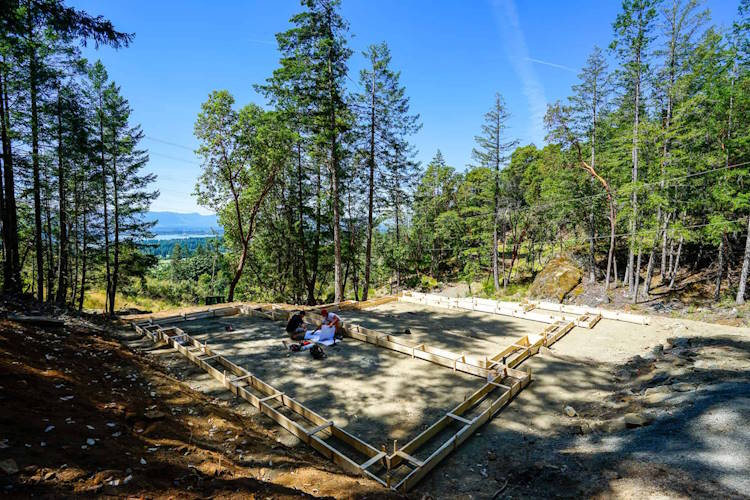
- Is there is a lot of rock on your property? You may need to add room in your budget for blasting.
- It is usually not easy to know where the bearing soil is under the surface. Having to dig deeper will impact the cost of excavation and groundwork overall.
- Subdivision lots are almost always cheaper to build on. Sewer, storm-water, and water services are usually provided for these lots.
- A small subdivision lot could restrict the home design related to setbacks and height limitations. If there are existing homes on the adjacent lots, that can also increase cost. Workers will have less room to work, material delivery can be impacted, and sometimes protective measures must be undertaken.
- Smaller lots can mean having to truck away excavated soil, as the lots do not have the room to store it.
- Is there an existing house to tear down and remove? This cost usually ranges from $30,000-$100,000.
- Generally, a sloped lot will cost more to build on than a flat lot. The design of your home will be tailored to the current and/or finished grade of the lot.
These are all factors that can cause the groundwork part of building your home to cost more. These increases cost in time, labour, and materials. They will all increase the cost per square foot to build your home.
How Does Design Impact Cost to Build?
Working with an experienced builder early in the design phase can help control costs and avoid surprises. At Made to Last, we guide clients through design decisions to align their vision with their budget.
Some examples of how the home design can impact cost per square foot:
- A multi-level home will cost less per square foot than a rancher, as it has a smaller footprint.
- Larger homes cost less per square foot than smaller homes, as many of the costs are spread out.
- Extra decking, particularly covered decking, will add cost to the home.
- Homes with more or larger windows and doors often cost more. This is due to engineering challenges. Windows and doors themselves might not cost more than the siding and drywall they replace (unless they are quite large or higher end). However, an engineer must specify how to create the seismic strength in the home that we require on Vancouver Island.
- Kitchens and bathrooms are the two most expensive rooms in a home. Multiple bathrooms in the floor plan of your home will mean a higher cost per square foot to build. A home of similar size, with fewer bathrooms, would cost less.
- Homes with a more intricate roof layout will cost more than a simple design (potentially a 500% total increase to roof structure materials, labour, roofing product, gutters, and soffits).
- More jogs in the exterior of the house will cost more to build than a basic design, as it increases wall surface area.
- More intricacy in the design, like adding ceiling vaults, large walls of windows, or exterior wall jogs, decreases the energy efficiency of a home. Not only are these more expensive features, they will add costs to improve other aspects of the home in order to meet BC Step Code requirements.
- Made to Last often does not include the square footage of a garage in discussions of cost per square foot. But, the presence or size of a garage impacts the overall cost.
Our design-build process helps clients make informed decisions early, reducing costly changes later.
How Do Finishing Choices Impact Cost Per Square Foot?
A client’s finishing choices can easily make up 50% of a home’s cost. Many builders give very small allowances for finishing costs in their estimates. Made to Last prefers to understand a client’s desires and budget before establishing allowances.
Finishing items include:
- Exterior items: roofing, windows, exterior doors & hardware, decking, deck railings, and siding materials.
- Special exterior details: natural wood posts and beams, wood soffits, gutter guards, and unique downspouts.
- Driveways and sidewalks.
- Plumbing and electrical fixtures, as well as electrical layout (how many lights, switches, and plugs).
- Heating and cooling choices, including potential fireplaces.
- Appliances
- Interior items: flooring, cabinetry, countertops, interior doors & hardware, interior paint (including quality of paint, level of finish, and amount of colours).
- Interior trim details: baseboards, window trim, and stairwell railing choices.
- Closet materials, bathroom holders, mirrors, and fireplace mantles.
At Made to Last, we can perform a preliminary product selection process with you as part of the home design. This saves you costs and helps keep you on budget. However, for a custom home, there is no limit to the number of options you can consider. For clients with more budget flexibility and who want to consider a large amount of finishing choices, we recommend using an interior designer when investigating your finishes. An interior designer can help you source more unique products, create a cohesive overall design, and avoid making design decisions you may reconsider later.
Building From Out of Province?
If you’re planning to build on Vancouver Island but live elsewhere, understanding costs and logistics can be more complex.
We offer a construction feasibility assessment to help you evaluate your lot, budget, and project scope before committing.
Learn more about our construction feasibility assessment
Read our feasibility FAQ
Real Cost Trends (2019–2026)
The construction industry has seen significant cost increases in recent years.
Here’s how pricing has evolved:
- 2019: Starting around $250 per sq ft
- 2021-2022: $260-$450 per sq ft (17 homes completed)
- 2023: $290-$575 per sq ft
- 2024-2025: $350-$600+ per sq ft (including permits, taxes, and major systems)
Today, we recommend clients plan for a minimum of $350 per square foot for a realistic custom home budget.
While lower costs are sometimes possible, they typically require consistent compromises in design, materials, and finishes.
You can also explore our recent custom home projects to see the level of quality and detail we deliver.
Thinking About Building a Custom Home?
The best way to understand your true cost is through a detailed estimate based on your specific design, lot, and goals.
We offer an initial exploratory meeting where we provide a Pre-Design Estimate to help you plan with confidence. Contact us today to book an exploratory meeting. After you make the choice to have us help guide you through the home-building process, we begin to design and choose products for your custom homes. Once the house is fully designed, we establish an accurate Estimate based on quotes and prices for the actual home.
We hope this helps you to have a better understanding of the cost to build a home in the Cowichan Valley and on Vancouver Island.
Book a ConsultationIf you found this helpful, you may also enjoy reading: Why and How to Choose a Custom Home Builder.